



AI advancement fueled by efficient energy storage.
I’ve always been interested in battery tech and how to squeeze just a bit more. Check out the story below 👇 the perspective may help not just in this tech, but in others aswell.
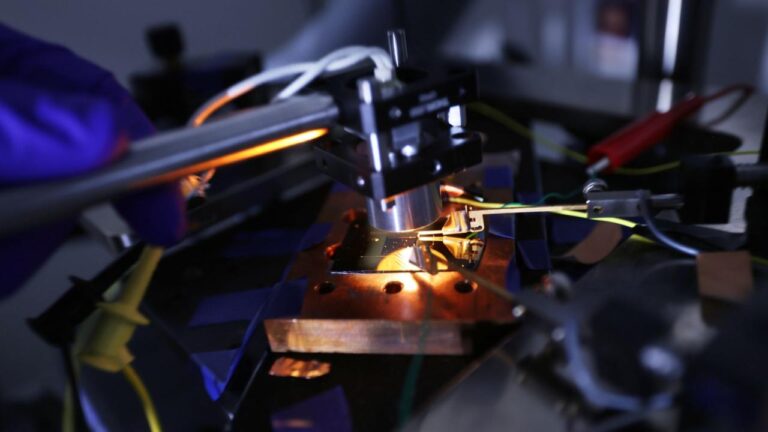
Researchers at the University of Michigan have crafted an “air bridge” in thermophotovoltaic (TPV) cells, enhancing energy transfer and storage. Their new device achieves a 44% efficiency at 2,615°F (1,435°C), a significant improvement over previous designs.
The TPV cells convert heat into electricity using lower-energy infrared photons. Positioned around material heated to at least 1,000°C, these cells can store energy from renewable sources or industrial processes. According to Andrej Lenert, U-M associate professor, “Using electricity to heat something up is a simple and inexpensive method to store energy relative to lithium-ion batteries.”
To improve efficiency, researchers integrated a thin air layer in the TPV cell, beyond the semiconductor, with a gold reflector beyond the air gap. This “air bridge” traps useful photons while redirecting the rest back into the heat storage material for re-emission.
Efficient heat-to-electricity conversion from TPV technology offers an interesting opportunity to a renewable power source. As AI systems demand more energy, advancements in TPV efficiency can support this growth sustainably, aiding #ai, #genai, and even #quantum development contributing to a gain in efficiency at heat dispersion.
𝗡𝗼𝘁𝗶𝗰𝗲: The views within any of my posts, or newsletters are not those of my employer or the employers of any contributing experts. 𝗟𝗶𝗸𝗲 👍 this? feel free to reshare, repost, and join the conversation.
